Housing, Health, Education, Pension & Welfare (Eligibility + Benefits Explained)
Government schemes in India are created to support poor, lower-middle, and middle-class families by reducing their financial burden in essential areas like housing, healthcare, education, employment, food security, and old-age protection.
In 2026, rising inflation, medical costs, education fees, and unstable private jobs have made these schemes more important than ever, especially for people living in villages, small towns, and lower-income urban areas.
This complete guide explains:
- Which schemes are available
- Who can apply
- Eligibility conditions
- Benefits provided
- How these schemes help in real life
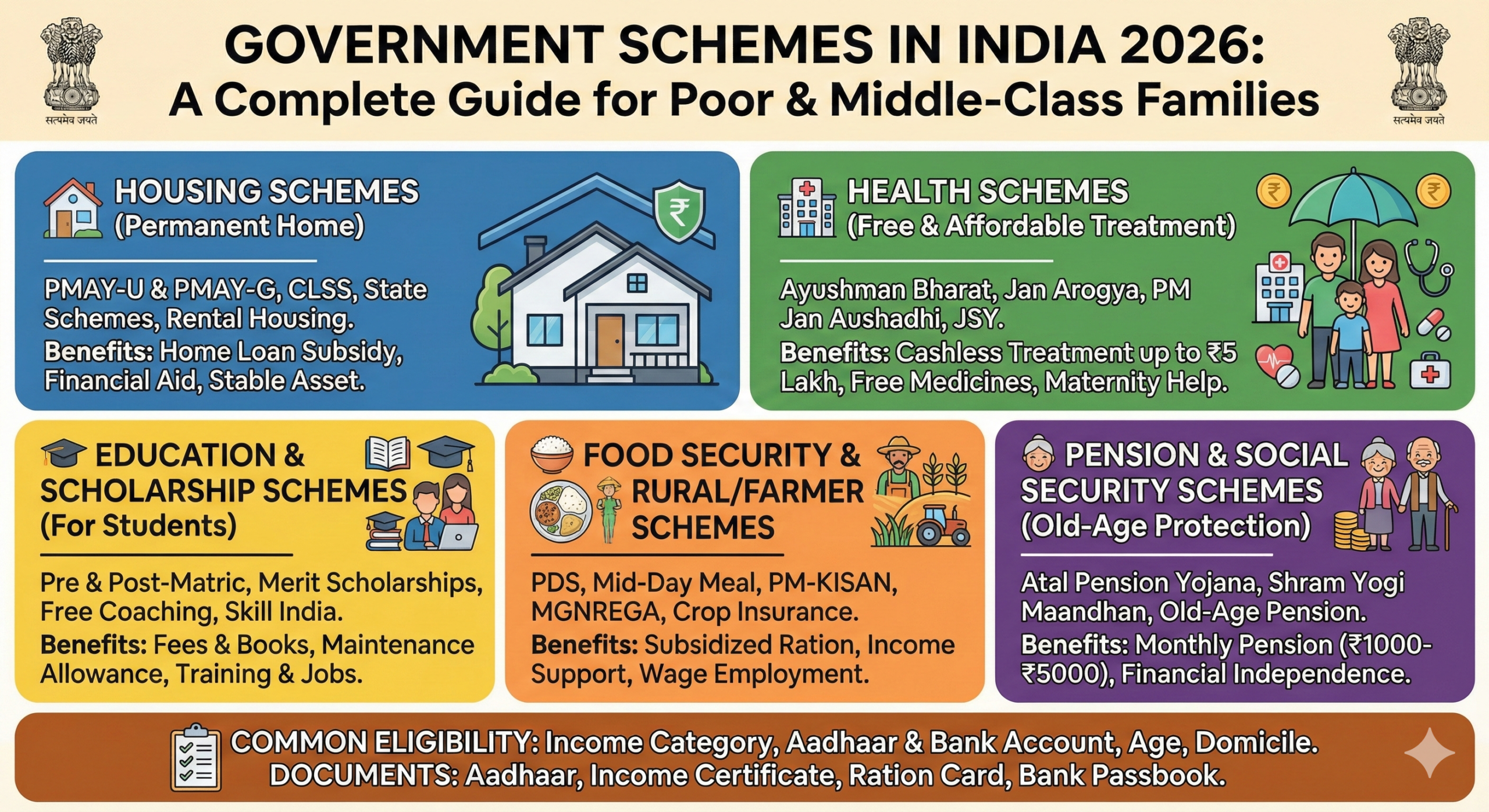
🏠 HOUSING SCHEMES (Permanent Home & Stability)
Housing is the foundation of financial and social security. Government housing schemes help families move from rented or kutcha houses to safe, permanent homes.
Major Housing Schemes (Central & State)
| Scheme Name | Beneficiaries | Eligibility | Benefits |
|---|---|---|---|
| Pradhan Mantri Awas Yojana – Urban (PMAY-U) | Urban poor & middle class | No pucca house, income under EWS/LIG/MIG limits | Home loan subsidy up to ₹2.67 lakh |
| Pradhan Mantri Awas Yojana – Gramin (PMAY-G) | Rural poor | Kutcha house or homeless | Financial help to build pucca house |
| Credit Linked Subsidy Scheme (CLSS) | Middle-income families | Home loan + income criteria | Reduced interest on housing loan |
| Affordable Rental Housing Complex (ARHC) | Migrant & urban poor | Urban residents without own house | Low-rent government housing |
| State Housing Schemes | State residents | Income + domicile based | Extra subsidy & low-cost flats |
Why housing schemes matter
- Reduce rent burden
- Create permanent family assets
- Improve safety, sanitation, and dignity
🏥 HEALTH SCHEMES (Free & Affordable Treatment)
Medical expenses are the biggest reason families fall into debt. Health schemes protect families from costly hospital bills.
Major Health Schemes
| Scheme Name | Beneficiaries | Eligibility | Benefits |
|---|---|---|---|
| Ayushman Bharat (PM-JAY) | Poor families | SECC / ration card holders | Cashless treatment up to ₹5 lakh/year |
| Jan Arogya Yojana | Economically weaker families | Govt-approved list | Free hospital treatment |
| PM Jan Aushadhi Yojana | All citizens | No income limit | Low-cost generic medicines |
| Janani Suraksha Yojana (JSY) | Pregnant women | BPL/SC/ST/rural women | Financial help for safe delivery |
| State Health Insurance Schemes | State residents | Income & category based | Free or subsidized treatment |
Why health schemes matter
- Prevent selling land or gold for treatment
- Ensure access to quality hospitals
- Reduce long-term medical debt
🎓 EDUCATION & SCHOLARSHIP SCHEMES (For Students)
Education schemes ensure that lack of money does not stop talent.
Major Education Schemes
| Scheme Name | Beneficiaries | Eligibility | Benefits |
|---|---|---|---|
| Pre-Matric Scholarship | School students | SC/ST/OBC + income limit | Fees, books, uniforms |
| Post-Matric Scholarship | College students | SC/ST/OBC + income limit | Tuition + maintenance allowance |
| National Means-cum-Merit Scholarship | Class 9–12 | Merit + low income | ₹12,000 per year |
| PM Scholarship Scheme | Higher education students | Merit & income based | Financial assistance |
| Free Coaching Schemes | Exam aspirants | SC/OBC/Minority + income | Free coaching + stipend |
| Skill India / PMKVY | Youth | Age 18–45 | Free skill training |
Why education schemes matter
- Reduce dropout rates
- Support higher education
- Improve employment opportunities
👵 PENSION & SOCIAL SECURITY SCHEMES (Old-Age Protection)
These schemes protect people who do not have salaried retirement benefits.
Major Pension Schemes
| Scheme Name | Beneficiaries | Eligibility | Benefits |
|---|---|---|---|
| Atal Pension Yojana (APY) | Poor & middle class | Age 18–40, bank account | Pension ₹1,000–₹5,000 |
| PM Shram Yogi Maandhan | Unorganised workers | Low income, age 18–40 | ₹3,000 pension after 60 |
| National Social Assistance Programme | Elderly, widows | BPL families | Monthly assistance |
| State Old-Age Pension Schemes | State residents | Age & income based | Monthly pension |
| Widow & Disability Pension | Widows & PwD | Certificate based | Monthly support |
Why pension schemes matter
- Financial independence in old age
- Reduced dependency on children
- Dignity after retirement
🍚 FOOD SECURITY SCHEMES (No One Sleeps Hungry)
| Scheme Name | Beneficiaries | Benefits |
|---|---|---|
| Public Distribution System (PDS) | Poor families | Free/subsidized ration |
| Antyodaya Anna Yojana (AAY) | Poorest families | Highly subsidized food |
| One Nation One Ration Card | Migrant workers | Ration anywhere in India |
| Mid-Day Meal Scheme | School children | Free nutritious meals |
| Anganwadi Services | Mothers & children | Nutrition & health support |
🧑🌾 FARMER & RURAL EMPLOYMENT SCHEMES
| Scheme Name | Beneficiaries | Benefits |
|---|---|---|
| PM-KISAN | Small farmers | ₹6,000 yearly income |
| PM Fasal Bima Yojana | Farmers | Crop loss insurance |
| MGNREGA | Rural poor | 100 days wage work |
| Kisan Credit Card (KCC) | Farmers | Low-interest loans |
| State Farmer Schemes | State farmers | Extra financial aid |
👩 WOMEN & GIRL CHILD SCHEMES
| Scheme Name | Beneficiaries | Benefits |
|---|---|---|
| Beti Bachao Beti Padhao | Girl children | Education & awareness |
| Sukanya Samriddhi Yojana | Girl child | High-interest savings |
| Ujjwala Yojana | Poor women | Free LPG connection |
| State Women Welfare Schemes | Women | Financial & social support |
📄 COMMON ELIGIBILITY CONDITIONS
Most schemes depend on:
- Income category (BPL/EWS/LIG/MIG)
- Aadhaar & bank account
- Age
- Domicile (for state schemes)
- Category (SC/ST/OBC/Minority)
Common Documents Required
- Aadhaar card
- Income certificate
- Ration card
- Bank passbook
- Residence proof
✅ Final Conclusion
Government schemes are powerful support systems, not charity.
They exist to protect poor and middle-class families from housing insecurity, medical debt, education dropouts, hunger, unemployment, and old-age poverty.
If you belong to the poor or middle class, these schemes can:
- Save thousands of rupees every year
- Improve quality of life
- Create long-term stability for your family
Awareness is the key. Most people miss benefits simply because they do not know these schemes exist.
1. Can middle-class families apply for government schemes?
Yes. Many schemes such as PMAY (MIG category), Atal Pension Yojana, Sukanya Samriddhi Yojana, education scholarships, and health schemes are specifically designed for the middle class.
2.How do I know if I am eligible for a government scheme?
Eligibility usually depends on:
Annual family income
Age
Category (SC/ST/OBC/General)
Residence (rural/urban or state domicile)
Bank account and Aadhaar
You should always check the official notification before applying.
3.Which government scheme is best for housing?
The Pradhan Mantri Awas Yojana (PMAY) is the most important housing scheme for poor and middle-class families, offering interest subsidy and financial assistance for building or buying a home.
4.What is the best government health scheme in India?
Ayushman Bharat (PM-JAY) is the biggest health scheme, providing cashless treatment up to ₹5 lakh per family per year in empanelled hospitals.
5.Which pension scheme is best for unorganised workers?
The Pradhan Mantri Shram Yogi Maandhan Yojana and Atal Pension Yojana (APY) are best for unorganised workers and low-income earners, providing monthly pension after 60 years.