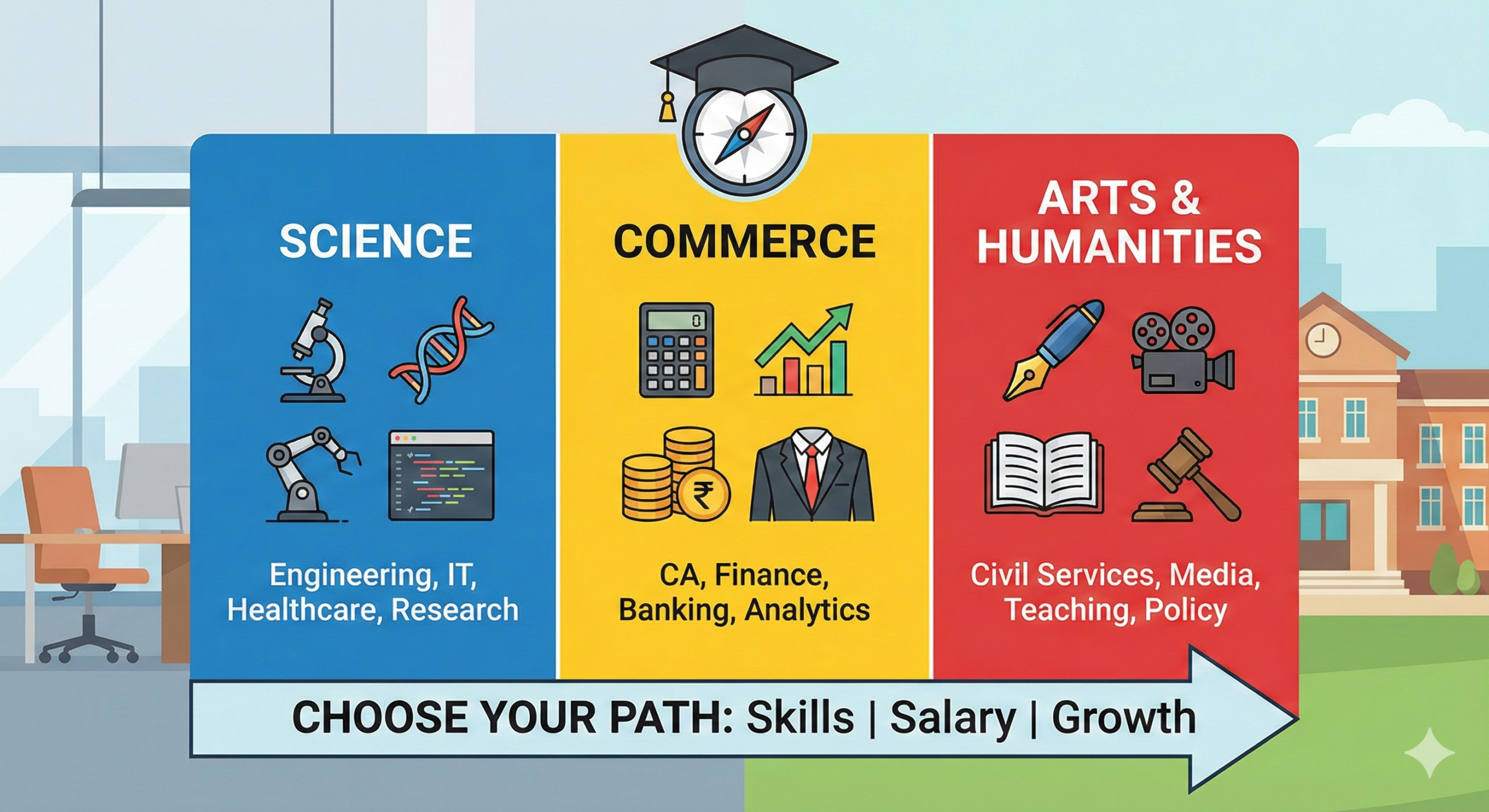
Choosing a career after graduation is one of the most important decisions you’ll make. This guides breaks down the best career paths for Science, Arts (Humanities) and Commerce graduates in India, explains the skills you need, gives realistic salary ranges, analyses the growth outlook, and shows actionable, real-life-style examples so you can pick a path that fits your strengths and life goals.
How to read this post
- If you’re a Science graduate → jump to Science careers.
- If you’re an Arts / Humanities graduate → jump to Arts careers.
- If you’re a Commerce graduate → jump to Commerce careers.
- Every section contains: top options → core skills → salary reality → growth outlook → example roadmap.
Quick decision checklist (pick a path if you answer “yes” to one)
- Do you like numbers and markets? → Commerce paths.
- Do you enjoy experiments, coding, or labs? → Science paths.
- Do you enjoy writing, teaching, policy, or social work? → Arts/Humanities paths.
- Prefer secure govt job vs faster private growth? Decide between public sector (UPS C, PSUs, banks) and private sector (tech, finance, media).
1. Top Careers for Science Graduates
Science degrees (BSc, B-Tech, B-Pharm, BSc Nursing) unlock technical, research, healthcare, and engineering careers. With high demands in the markets and high salary package. This field is one of the best career options anone can choose.
A. Engineering & Core Technology (B.Tech / BE)
What you do: Design, build and maintain systems — from software to bridges and power plants.
Skills required: Problem solving, programming (for CSE), CAD & simulation (for mechanical/civil), domain mathematics, communication.
Salary reality (freshers): ₹3–8 LPA (private startups/SMEs: ₹2.5–5 LPA; large IT & product companies: ₹6–20 LPA; core OEMs: ₹3–8 LPA).
5-year outlook: ₹6–20 LPA depending on company and skill growth. Senior engineers, team leads, or product managers often cross ₹20–40 LPA.
Growth outlook: Strong in software, AI/ML, cloud; steady in civil/mechanical with cyclic demand tied to infrastructure.
Example roadmap:
- Year 0–1: Internships, GitHub projects, campus placements.
- Year 2–3: Specialize (cloud, ML, embedded), pursue certifications.
- Year 4–5: Move to product companies or niche roles (SRE, data engineer).
B. Information Technology & Software (including data science)
What you do: Build apps, data pipelines, analyze large datasets.
Skills required: Programming (Python/Java), data structures, SQL, ML basics, cloud fundamentals. Soft skills for product roles.
Salary reality (freshers): ₹4–12 LPA (Big Tech & well-funded startups higher).
Growth outlook: Excellent — business transformation and data-led products keep demand high.
Example: A BSc Computer Science topper joins an analytics start-up at ₹6 LPA, learns SQL & Python, and after two years moves to a product firm at ₹15 LPA.
C. Healthcare & Allied (MBBS, BDS, BPharm, Nursing, Allied health)
What you do: Clinical care, diagnostics, pharmacy, hospital management.
Skills required: Clinical knowledge, empathy, steady hands (for surgeons), lab techniques, regulatory knowledge (for pharma).
Salary reality:
- MBBS junior doctors start around ₹6–12 LPA in private hospitals; government residencies differ.
- BPharm freshers ₹2–4 LPA (industry), clinical roles higher.
- Nurses: ₹2–6 LPA, rising with experience or abroad.
Growth outlook: Very strong — healthcare demand increases with population and aging. Telemedicine and pharma R&D also growing.
Example roadmap: MBBS → MD specialization → government hospital posting or private practice. Specialist consultants earn much higher incomes over time.
D. Research & Scientific Careers (ISRO, DRDO, CSIR labs)
What you do: Fundamental/applied research, product development, national projects.
Skills required: Domain expertise, research methods, programming/math for computational research, publications for academic roles.
Salary reality: Entry-level research scientist roles may start ~₹6–12 LPA in premium labs/PSUs; academic lecturer salaries vary.
Growth outlook: High in space, defence tech, renewable energy and biotech.
Entity example: ISRO hires engineers/researchers through GATE/DRC routes.
2. Top Careers for Arts / Humanities Graduates
Arts grads (BA, BSW, BFA, BCom(Humanities)) have diverse paths: civil services, media, teaching, design, and policy.
A. Civil Services & Public Policy (UPSC, State PSC)
What you do: Policy making, district administration, judiciary-adjacent roles.
Skills required: Writing, current affairs, critical thinking, optional subject expertise, interview skills.
Salary reality: IAS/IPS officers (after allowances) can earn ₹70k–₹2+ LPA initially; perks and housing make total compensation attractive.
Growth outlook: Stable long-term with social prestige.
Entity example: UPSC — prepare 9–18 months with structured guidance.
Example roadmap: BA → serious UPSC prep + coaching → state cadre posting → district collector in 6–12 years (depending on rank).
B. Media, Content & Creative (Journalism, Copywriting, Film, Design)
What you do: Storytelling: print, digital, video, ads, design.
Skills required: Writing, interviewing, visual storytelling, basic video editing, SEO, social media strategy.
Salary reality: Wide range. Freshers ₹2–5 LPA in local outlets; national media, content marketing roles ₹6–15 LPA; successful creators/filmmakers can earn much more.
Growth outlook: Digital content demand keeps rising; specialization (SEO, data journalism) helps.
Example: BA in English → content writing agency → grows to content lead with ₹10 LPA and switches to niche technical writing.
C. Teaching & Academia
What you do: School/college teaching, curriculum design, ed-tech.
Skills required: Subject mastery, pedagogy, communication. NET/UGC for college roles.
Salary reality: School teachers ₹2.5–7 LPA; college lecturers ₹4–10 LPA (varies with college and state). Private coaching can be lucrative.
Growth outlook: Steady; ed-tech expands opportunities for online tutoring and course creation.
D. Social Work & Development Sector
What you do: NGO work, project management, grants, community programmes.
Skills required: Project management, fieldwork, data collection, empathy, report-writing.
Salary reality: Entry ₹2–4 LPA; experienced project managers ₹6–12 LPA; international NGOs pay higher.
Example: BSW graduate joins a health NGO, gains project management experience, later leads programs with donor funding.
3. Top Careers for Commerce Graduates
Commerce (BCom, BBA, BBS) offers finance, accounting, banking, taxation and business roles.
A. Chartered Accountancy (CA)
What you do: Audit, taxation, financial advisory, CFO track.
Skills required: Accounting, tax law, Excel, audit methodology, client skills.
Salary reality: CA trainees ₹3–7 LPA; post-qualification ₹8–25 LPA (in India), higher in corporate/consulting.
Growth outlook: Excellent — CAs are vital for finance, startups, MNCs.
Example roadmap: BCom → CA articleship → qualify → join Big4 or industry, climb to CFO roles.
B. Banking & Finance (IBPS, SBI, RBI, Investment Banking)
What you do: Retail banking, risk, credit analysis, investment banking, wealth management.
Skills required: Accounting, Excel, communication, risk modeling (for IB), coding for quant roles.
Salary reality:
- Bank PO: ₹6–12 LPA with perks.
- Investment banking analysts: ₹8–25 LPA (entry, varies widely).
Entity example: RBI offers specialized exams (Grade B) with high pay and policy roles.
Growth outlook: Stable for retail banking; high volatility but high pay in investment banking & fintech.
C. Company Secretary (CS) & CMA
What you do: Corporate compliance (CS), management accounting (CMA).
Skills required: Corporate law, compliance, financial analysis.
Salary reality: Entry ₹4–8 LPA; experienced corporate secretaries/CFOs higher.
Growth outlook: Good in regulated industries and listed companies.
D. Data Analytics & Business Intelligence
What you do: Analyze data to help businesses make decisions.
Skills required: Excel, SQL, Power BI/Tableau, basic stats, communication.
Salary reality: Freshers ₹4–8 LPA; experienced analysts ₹8–20 LPA.
Growth outlook: Very strong — every business needs analytics.
4. Cross-Stream High-Value Options (open to all graduates)
A. MBA / Management
What you do: Business strategy, marketing, operations, HR.
Skills required: Analytical thinking, communication, internships, problem solving.
Salary reality: Tier-1 B-school grads ₹20–40 LPA (avg). Tier-2/3 ₹6–15 LPA. ROI depends on school and specialization.
When to choose: Prefer after 2–3 years of work for better ROI.
B. Law (LLB)
What you do: Litigation, corporate law, compliance.
Skills required: Legal reasoning, research, advocacy.
Salary reality: Fresh law firm associates ₹3–8 LPA; corporate counsels higher with experience.
Growth outlook: Good, especially in corporate/compliance law.
C. Civil Services (UPSC)
Open to graduates of any stream — high stability, social impact and prestige.
5. Skills Employers Actually Value (across streams)
- Communication: Written + spoken English/Hindi/local language.
- Problem-solving & critical thinking.
- Digital literacy: Excel, Google Workspace, basic coding or analytics.
- Domain depth: One specialized skill (e.g., ML for CS, tax for commerce, clinical skills for medicine).
- Soft skills: Teamwork, deadlines, client handling.
- Learning agility: Ability to pick new tools quickly.
6. Salary Reality — What to Expect (India averages, 2026-aware guidance)
These are realistic ranges for early career (0–3 years) and mid-career (4–10 years). Actual pay varies widely by city, employer, and individual skill.
| Stream / Role | Entry (0–3 yrs) | Mid (4–10 yrs) |
|---|---|---|
| IT / Software | ₹4–12 LPA | ₹10–30 LPA |
| Engineering (core) | ₹3–8 LPA | ₹6–20 LPA |
| Medical (MBBS) | ₹6–12 LPA (residency) | ₹15–60+ LPA (specialist/private) |
| CA / Finance | ₹3–8 LPA (articles) | ₹10–40+ LPA |
| Banking (PO) | ₹6–12 LPA | ₹8–25 LPA |
| Civil Services | Pay bands + allowances | Senior roles significant (collector/secretary) |
| Teaching (School) | ₹2.5–6 LPA | ₹5–12 LPA |
| Media / Content | ₹2–6 LPA | ₹6–18 LPA |
| Data Analytics | ₹4–8 LPA | ₹8–25 LPA |
7. Growth Outlook — Which Sectors Will Grow Fastest?
- Technology & AI — ongoing automation and product growth.
- Healthcare & Pharma — aging population and R&D.
- Renewables & Infrastructure — government push + private investment.
- Financial services & Fintech — digital banking, payments.
- EdTech & Online Learning — lifelong learning demand.
8. Realistic Example Profiles (composite, not real persons)
Example 1 — Riya (Science → Data Science)
- Degree: BSc (Computer Science)
- Actions: Interned, did projects on Kaggle, learned Python & ML, joined a startup at ₹6 LPA.
- 3 years: Moved to product firm at ₹18 LPA as Data Scientist.
- Takeaway: Build portfolio, contribute to open-source, network.
Example 2 — Amit (Commerce → CA)
- Degree: BCom
- Actions: Started CA, joined Big4 articleship, passed finals in 4 years.
- 5 years: Senior in tax practice, salary ₹20 LPA.
- Takeaway: CA requires sacrifice early but leads to strong finance careers.
Example 3 — Sunita (Arts → Civil Services)
- Degree: BA (History)
- Actions: 1.5 years prep, joined coaching for optional subject, cleared UPSC.
- Outcome: District administration posting in home state.
- Takeaway: Arts graduates with discipline can reach top administrative roles.
9. How to Choose — Practical Decision Matrix
- List 3–5 things you enjoy doing (coding, teaching, analyzing, writing).
- Match them to career families above.
- Check eligibility & time to enter (e.g., CA timeline, MBBS entrance).
- Do 1 internship/project in shortlisted field before committing.
- Choose one primary path + one backup (e.g., Banking + Data Analytics).
10. Action Plan — 12 Month Roadmap (for any graduate)
- Month 0–2: Self-assess; pick 1 primary path.
- Month 2–6: Build basic skills (online courses, certifications).
- Month 6–9: Intern / volunteer / freelance small projects.
- Month 9–12: Apply for jobs/entrance exams; polish resume and interview skills.
- Ongoing: Read industry news, network on LinkedIn, keep learning.
Final Thoughts
Graduation is a starting line — not a deadline. The most successful careers combine skills, consistent effort, and smart choices. Pick one path, build skills that employers value, and keep learning. With the right approach, every stream — Science, Arts, Commerce — can lead to a fulfilling and well-paid career in India.
1.Which career is best after graduation in India?
There is no one “best”. Choose a career that matches your strengths, market demand (IT, healthcare, finance), and lifestyle preferences.
2.Is an MBA worth it right after graduation?
Not usually — work experience (2–3 years) before an MBA yields much better ROI unless you secure a top-tier B-school immediately.
3.Can Arts graduates get high-paying jobs?
Yes — through civil services, law, content leadership, UX design, and specialized roles (data journalism). Skills and niche expertise matter.
4.How important is an internship?
Crucial. Internships give practical exposure, help build a portfolio, and significantly improve placement chances.
5.Should I pursue government jobs or private sector?
Depends on preference: government jobs offer stability and social impact; private sector often offers faster pay growth.