
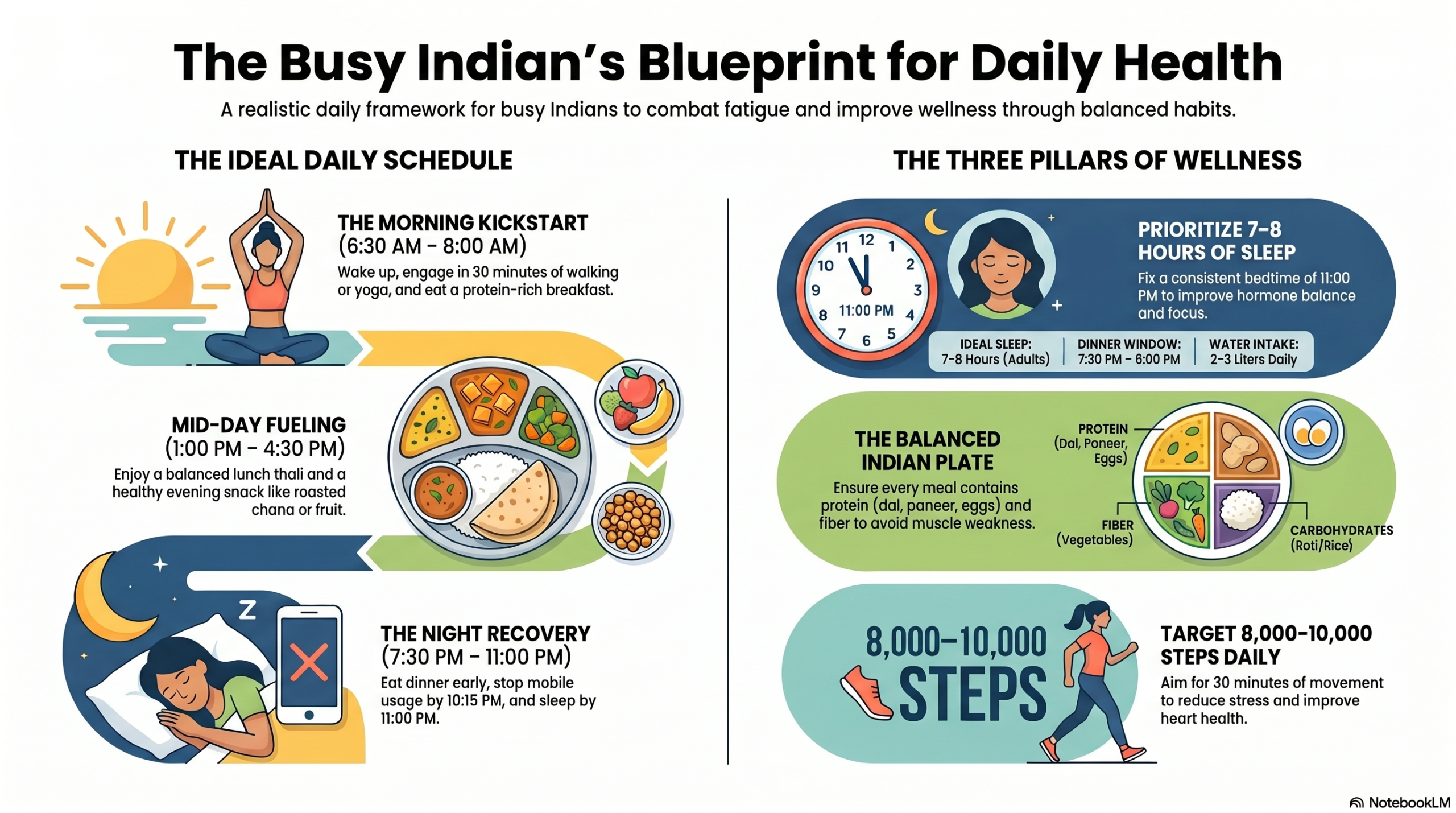
Introduction: Why Most Indians Feel Tired Today
In today’s fast-moving life, many Indians—whether working professionals, students, or homemakers—face the same problems:
- Constant tiredness
- Poor sleep
- Weight gain
- Stress and anxiety
- Irregular eating habits
The issue is not lack of effort.
The real problem is lack of a proper daily routine.
Most people try:
- Skipping meals
- Sleeping late
- Random exercise
- Weekend “health fixes”
But health is not built in one day.
It is built through daily habits.
This guide will help you build a realistic and sustainable daily routine based on:
- 💤 Sleep
- 🍛 Diet
- 🏃 Activity
That fits perfectly into a busy Indian lifestyle.
PART 1: Sleep – The Foundation of Your Health
Sleep is the most ignored part of health in India.
Many people think:
“Sleep kam bhi chalega”
But scientifically, sleep controls your entire body.
Why Sleep Is So Important (Simple Science)
When you sleep:
- Your body repairs itself
- Your brain processes information
- Hormones balance
- Fat burning improves
- Stress reduces
When you don’t sleep properly:
- You feel tired all day
- You gain weight easily
- You crave junk food
- You lose focus
How Much Sleep Do You Need?
| Age Group | Ideal Sleep |
|---|---|
| Adults | 7–8 hours |
| Students | 7–9 hours |
Sleeping less than 6 hours regularly is harmful.
Why Indians Struggle With Sleep
Common habits:
- Late dinner (after 10 PM)
- Mobile usage till midnight
- Watching OTT shows
- Stress from work
- Too much tea/coffee
These habits disturb your body clock.
How to Fix Your Sleep Routine (Step-by-Step)
1. Fix a Sleep Time
Try:
- Sleep by 10:30–11 PM
- Wake by 6–7 AM
Your body loves routine.
2. Reduce Mobile Before Sleep
Stop phone use at least 30–45 minutes before bed.
Instead:
- Read something light
- Talk to family
- Do deep breathing
3. Eat Dinner Early
Best time:
7:30–9 PM
Late heavy dinner causes:
- Acidity
- Poor sleep
- Weight gain
4. Create a Sleep-Friendly Environment
- Dim lights
- Clean bed
- No loud noise
Real-Life Example
A working professional sleeping at 1 AM daily shifted to 11 PM.
Within 3 weeks:
- Better energy
- Less stress
- Improved digestion
Sleep is the base of your routine.
PART 2: Diet – Healthy Eating for Indian Lifestyle
You don’t need expensive diets.
Indian food is already balanced—if eaten properly.
The Biggest Diet Problems in India
- Skipping breakfast
- Too much tea (4–5 cups daily)
- Oily snacks
- Eating late at night
- Low protein intake
What Is a Balanced Indian Diet?
Every meal should include:
- Protein (dal, eggs, paneer, curd)
- Fiber (sabzi, salad)
- Carbs (roti, rice)
- Healthy fats (nuts, small ghee)
Morning Routine (Start Right)
After waking:
- 1 glass warm water
- Optional: soaked almonds
Healthy Breakfast Options
- Poha with peanuts
- Vegetable upma
- Idli + sambar
- Eggs + roti
- Oats + curd
Avoid:
❌ Only chai + biscuit
Lunch Routine
Typical Indian thali is perfect:
- Roti
- Dal
- Sabzi
- Rice (small portion)
- Salad
- Curd
Eat slowly and mindfully.
Evening Snacks
Choose:
- Roasted chana
- Fruits
- Buttermilk
Avoid daily:
- Samosa
- Chips
- Sugary tea
Dinner Routine
Keep it light.
Good options:
- 2 rotis + sabzi
- Khichdi
- Dal + salad
Avoid:
- Heavy dinner after 10 PM
Why Protein Is Important
Most Indians eat too many carbs and less protein.
Low protein causes:
- Weak muscles
- Weight gain
- Hair fall
Include daily:
- Dal
- Curd
- Eggs or paneer
Hydration Rule
Drink:
2–3 liters water daily
Real-Life Example
A student replaced junk snacks with fruits and chana.
In 2 months:
- Lost weight
- Felt more energetic
- Improved concentration
PART 3: Physical Activity – Movement Without Gym
You don’t need a gym.
You need movement.
Why Activity Is Important
Physical movement:
- Improves heart health
- Reduces stress
- Helps in weight control
- Improves sleep
Minimum Activity Needed
- 30 minutes daily
- 8,000–10,000 steps
Easy Activity Options
Walking
- Morning or evening walk
- Easy and effective
Home Workout
- Pushups
- Squats
- Plank
- Surya Namaskar
15–20 minutes is enough.
Yoga
Helps with:
- Flexibility
- Stress relief
- Back pain
For Office Workers
If you sit long hours:
- Stand every 45 minutes
- Stretch
- Walk during calls
Real-Life Example
An IT employee added 30-minute walking daily.
Result:
- Reduced back pain
- Better sleep
- Improved mood
Sample Daily Routine (Busy Indian Lifestyle)
| Time | Activity |
|---|---|
| 6:30 AM | Wake up |
| 7:00 AM | Walk / Yoga |
| 8:00 AM | Breakfast |
| 1:00 PM | Lunch |
| 4:30 PM | Snack |
| 7:30 PM | Dinner |
| 10:30 PM | Sleep preparation |
| 11:00 PM | Sleep |
Mental Health & Stress (Bonus but Important)
Even if diet and sleep are good, stress can damage health.
Simple Stress Control Methods
- 5 minutes deep breathing
- Meditation
- Talking to family
- Limiting social media
Long-Term Benefits of Healthy Routine
If you follow this routine:
- Better energy
- Better digestion
- Better focus
- Lower disease risk
After 6 months, results become clearly visible.
Final Conclusion
A healthy daily routine is not about perfection.
It is about small, consistent habits:
- Sleep on time
- Eat balanced food
- Move your body daily
You don’t need a fancy lifestyle.
You need discipline.
1.How many hours should I sleep daily?
Adults should sleep 7–8 hours daily.
2.Is Indian food healthy?
Yes, if balanced and eaten in proper quantity.
3.Do I need a gym to stay fit?
No. Walking and home exercises are enough.
4.What is the best time to sleep?
Between 10–11 PM.
5.Can busy people follow this routine?
Yes. It is designed for busy Indian lifestyles.